Showing posts with label media. Show all posts

Monday, 1 July 2013

19 years on, Prada has cast another black model... yes, this is the 21st century

It feels weird writing about momentous news when it doesn't sound quite as momentous as it should be. I am so glad that Prada has decided to cast a black model in its ad campaigns for the first time in 19 years - the last lucky lady was one Naomi Campbell, when we were in the age of the supermodel, back in '94 - but how on earth has it taken so long? Why has there been no black model deemed suitable in the interim? Unless I'm mistaken, the past two decades haven't exactly been devoid of candidates. 

Prada's first black model in an ad campaign for 19 years
 Malaika's high-profile ad for the upcoming season [Image via Jezebel.com]

Malaika Firth, the stunning British Kenyan model used in the Fall 13 campaign alongside famous Chinese model Fei Fei Sun, has now broken barriers in the fashion world for marking the turning point in this designer's campaigns. Miuccia Prada, whilst being a supremely talented woman, hasn't exactly done much for diversity in the past (see Jezebel), until she brought Jourdan Dunn onto the runway in 2008, which was seen as a revelation; please bear in mind, this was 2008, not 1908 - it should not have had to be a novelty. We should have been stamping down inequality on the catwalk decades ago, not just letting it slide because it's the done thing. There's making a trend, and then there's being narrow-minded.


Prada's advertising campaign with Naomi Campbell holding bag, 94
Naomi's 1994 campaign, shot by Steven Meisel [Image via Fashionbombdaily.com]

In case Prada wasn't sure who would have been good to hire between 1994 and 2013, here are a few suggestions for potential ad campaign stars:
  • Sessilee Lopez
  • Chanel Iman
  • Joan Smalls
  • Arlenis Sosa
  • Liya Kebede
  • Alek Wek
  • Nyasha Matonhodze (I know she's not as high profile as the others, but I think she'd make a great Prada girl - did you see her cover for Love Magazine?)
Basically, as amazing as it is to see Malaika and Fei Fei being given the nod by Miuccia, I think it's really sad that they've had to wait that long for the tide to turn. How can it be that 19 years is allowed to pass, during which we can assume non-white women don't wear Prada, buy into its branding or worship its designs (and, if they do, they're left feeling alienated and ignored)? This has to stop. 

P.S. If you want to read more about my writing on the catwalk's lack of ethnic diversity, check out my blog series. For more on body shapes and equality on the catwalk, click here.

Wednesday, 21 November 2012

How to Approach Fashion Bloggers: An Outreach Guide for PRs

 You need to stand out against the competition and be unique.
[Image my own, taken at London Fashion Week S/S13].

'Tis the season to be bombarded by PRs and marketing departments... yes, Christmas is upon us and many agencies and companies are approaching bloggers and needing their press release to be noticed. I've sat in both camps, PR/outreach and blogger, and I can safely say that it's easy to forget what it's like to be at the receiving end of your emails when you've spent ages working on a campaign and you have a never-ending list of people to contact. I totally get it. With this in mind, I've put together a few tips to make it a bit less stressful as you make your way through that blog list, and hopefully help you to achieve great results. 

1. DO make it personal


One of the laziest things you can do is to email without finding out the name of the blogger. Presumably you spent a few milliseconds/seconds/minutes looking at their posts, so it shouldn't take long to figure out their name, unless they deliberately prefer to remain anonymous. Simply writing: 'Hi, I love your great blog!' means you might as well admit that you're copying and pasting the same template email over and over again, and it doesn't matter how many kisses you put at the end to soften the impact (preferably none). Which blog do you love? Who has a bloody clue?! If you really loved their writing or photography so much then spend an extra two seconds referencing the post that caught your attention.

Most importantly, remember how annoying it is to receive post through your letterbox that's addressed to 'The Homeowner', because that's what you're effectively sending to the blogger. It's even worse if you don't even put any kind of greeting on the email at all, because that is being rude as well as being spam.

2. DON'T make us watch the party without an invite


Some PRs have an unusual strategy which is to prey on the Fear of Missing Out (FOMO) culture by sending bloggers images of press launches that they were not invited to. Perhaps the target audience will be so impressed by the sheer coolness of the fashion party that they were not cool enough to attend that they will be spurred on to create a brilliant blog post about the ones who were invited? The more likely option is that they will just stare in bemusement at the sheer audacity of the PR. 

Let's put it in a scenario: the most popular girl in your school hosts a party but doesn't invite you, then asks you to help distribute her photos from the night, as you might just be lusting over what some of her chosen few guests were wearing. Madness. The difference between these events and the ones that we willingly write about without the chance of an invite (such as the Met Ball in New York) is that I know the organisers of the Met Ball are not trying to squeeze me for publicity; I can look from afar and admire, without having my face rubbed in it that I'm at home in my pyjamas. I knew I wouldn't be walking the red carpet in New York but I was happy to go along for the ride.

3. DO make sure your product is right for the blog


The scatter-gun approach of targeting contacts may get you points for enthusiasm but it doesn't get you anywhere in the long run. If you're flogging anything and everything then don't send out a press release that covers your extensive range of gifts for babies and husbands unless your bloggers write about families and marriage. Seriously, I don't care how bespoke your Christmas presents are, I cannot feasibly write about them unless I become pregnant or engaged overnight which, let's face it, would be highly unlikely on both counts (though that would be a show-stopping blog post). 

Doing that little bit of research can save you a wasted email and will allow you to stop getting distracted with the pursuit of easy targets when you should be focusing on building quality relationships with interested bloggers who you can work with again in the future. And remember, you can be more specific with your target audience, so don't aim at a die-hard vintage blogger if your client's product is brand new and smells slightly of plastic. It's okay to be picky in order to cut out all those irrelevant pitches, because you're unlikely to get a great uptake rate if you're barking up the wrong tree in the style stakes.

4. DON'T forget the geography


It's an obvious one, but you'd be surprised how many emails I receive that are geographically irrelevant to me, bearing in mind that I don't make a secret of the fact that I'm based near London. New York Fashion Week looks fantastic and I'd love to go, but inviting me with a week's notice means that there's no way I can scrape together the money for a hotel, let alone a flight, much as I'd like to accept the invitation. Closer to home, I've been invited to events on the other side of London at short notice - presumably as a last resort, I'm under no illusions here - which are basically impossible for me to get to without arriving as the last revellers are heading home. I know a lot of my peers are in the same position, wondering why they've been asked to go to a city that is hundreds of miles away without much warning, and it is much more common in the travel industry where I work, but then that comes with the territory as travel is now full of adaptable digital nomads. Fashion? We're a bit more settled.

By all means ask someone on the off-chance if they can attend your event, as you never know when people might be travelling, but be honest and admit if you know it will be out of their way ("Paris to Edinburgh? Yeah, should be a doddle. Dunno why she's making a fuss."). All it takes is a quick look at their author bio or their Twitter feed to see where they're based and then you can work out if they should be able to attend without setting out on a two-day trek to reach you.

I honestly hope these tips help to reduce some of the mad panic surrounding this time of year for those of you in PR and outreach. If you want to share your own tips or insight then get in touch, as I'd love to hear your suggestions.

Sunday, 11 November 2012

Calculating Blogger ROI: Why Travel Bloggers Are Lightyears Ahead

Last week I headed off to World Travel Market (WTM) 2012, as part of my work, and it was a brilliant opportunity to find out what one of the blogging world's most innovative sectors is getting up to. Travel bloggers are some of the best networkers and negotiators, as well as being incredibly nice people, and they know how to make an impact. When I attended a seminar on how to measure a blogger's Return on Investment (ROI), I was fairly intrigued as to how this could be done, as a fashion blogger as well as a travel industry insider. 

Fashion Meets Travel: Calculating Your Worth as a Blogger
I figured this photo had the wanderlust/style crossover covered.
[Image my own, taken at a vintage fair in Brighton].

Knowing that the seminar was being run by Melvin Böcher of Traveldudes and Keith Jenkins of Velvet Escape, I felt that I'd be in pretty safe hands - these guys are two of the most successful bloggers in the travel sector and they certainly know what they're talking about. It was chaired by the head of TBU (Travel Bloggers Unite) and showed just how supportive and well integrated these bloggers are.

A Gap in the Market


"It seemed strange that there was no way to calculate ROI on my press trips, yet I had 80,000 unique visitors to Traveldudes," said Melvin, reflecting on his website. "In contrast, I worked on a local newspaper which had 30,000 unique visitors but also had 50 members of staff; I have assistance with Traveldudes but I am the only full-time person running it."


The idea was then planted to measure your blog's success based on a combination of factors such as your AVE (Advertising Value Equivalent), Google Analytics statistics and your impact on others, such as your scores on Klout and Peer Index as well as how much you could charge for a sponsored tweet. The overall rating, applying AVE principles to content and social media outreach, would then help organisations to work out if it would be good value to collaborate with you on press trips or other opportunities. 


Do you need to be psychic to calculate blogger ROI?
No, you don't need to be psychic to calculate ROI.
[Image my own, taken in Boston, USA].

Jo Johnson,deputy MD of 4BGB, said: "This is what has been missing in terms of evaluation. The travel industry really wasn't sure of the value of bloggers vs. print media. For example, the value of getting re-tweets hadn't ever been calculated, but it is important, such as if Melvin [with 100,000 followers] re-tweets you."

I can see why the travel industry is keen to improve evaluation and pinpoint those key bloggers - if you're working in fashion or beauty then you can easily send out samples or organise a press day and work to a smaller budget, whereas the travel industry is investing a lot more money in detailed press trips. What's also worth bearing in mind is that the majority of fashion bloggers are happy to post about product launches and deals, but their travel equivalents are a lot more wary about working with brands and often ask for payment. This means that developing a relationship with a blogger in travel is much more of a long-term investment and is not as simple as sending out a press release.


Your Search Visibility


Meanwhile Keith, from Velvet Escape, brought up an interesting point about how consumers find blogs and how they behave on them. "People might not cite bloggers as reasons for buying a holiday but if they use Google then, chances are, they will come across a blog in the results. They just don't realise that's what they've found, as more and more blogs look like online travel guides, so they think it's a website. Also, consumers don't tend to leave comments, but other bloggers do. Consumers tend to talk more on Twitter and Facebook."

In light of Keith's comments, it's worth bearing in mind that social proof is one of the best ways to target and grow your audience. That means if someone genuinely recommends a blog to their friends it is more trustworthy than a company, which people might assume had a hidden agenda.

What can we learn from the ROI calculator?


Now is the time to start finding out more about ROI. The calculator is currently free but will be available from €15 a month in the future, which is pretty reasonable for something that you can use to negotiate your future collaborations with brands. Plans for development include measuring newsletters with click-through rates, YouTube and Google Hangouts. 

The seminar definitely proved to me that travel bloggers are the savviest group when it comes to understanding their own worth and projecting their potential. If you're not in the sector but you want to follow their lead in terms of marketing yourself to brands then the ROI calculator is a great place to start.

Tuesday, 30 October 2012

Fashion Calendar: November and December - Maison Martin Margiela, iPhoneography and Refinery29

So, Christmas is coming and your downtime is suddenly thin on the ground, right? (I know mine is). It can be mind-boggling trying to stay on top of what's going on in the fashion world at the best of times, but I find that we all seem to go into a state of tunnel vision from now until December 25th, possibly due to an overdose of Wham! and Slade, and time just disappears. So I've put together this quick guide to three of the hottest fashion and culture events over the coming weeks - just cherry-pick your favourites.

November 15th = Maison Martin Margiela for H&M


Maison Martin Margiela for H&M Blue Dress
 Over-sized draped dress, £99.99, Maison Martin Margiela.
Sam Taylor-Johnson shot these images, which have a beautifully crisp finish.

Maison Martin Margiela for H&M Black Dress
 Draped dress in black, £99.99.
I'd style this with Vivienne Westwood suede ankle boots and a statement over-sized earring.

Maison Martin Margiela for H&M Plexi Wedge
 Jacket, £59.99; trousers with front seam, £59.99; wedge shoes in nude with plexi detail, £149.99.
 Having recently picked up very similar shoes from Office, I can definitely see the allure of the nude shoe with a plastic heel. They look challenging but would be fun to wear.

Maison Martin Margiela for H&M Bodysuit and Sweet Clutch
That sweet wrapper clutch bag, £34.99; nude body with bra print, £29.99; oversized jeans, £39.99.
If I had the washboard stomach I'd be adding this bodysuit to my shopping basket.
In the mean time, the pop art-style clutch will do nicely, thanks.
[Images via British Vogue].

You might have read recently about American eBay mysteriously gaining some MMMxH&M merchandise ahead of the official product launch, seemingly from the recent celebrity-laden press event. Light-fingered stars aside, you can't truly get your hands on any of the goods until 15th November, in selected stores from 9am. I'll be attending the exclusive preview event on 14th, courtesy of Vogue and one very lucky ticket draw, and I will be reporting back on the blog about what I find in Regent Street.

This is something of a dramatic contrast to H&M's previous collaboration, which was with the fashion editor du jour Anna Dello Russo, who is top fodder for street style bloggers around the world. Maison Martin Margiela is the opposite of fashion chameleon Anna, as the company's inner workings aren't well documented and the mysterious figurehead actually left the company several years ago. The brand itself continues to be enigmatic but always strives to push the boundaries of convention and conceptual thought. If you think fashion is art then you will love this collection. What's more, a mainline piece of Margiela will set you back hundreds, if not thousands, of pounds (case in point: a camel coat for men costs over a grand), so this is the one time us plebs have a chance of affording it. Thank you, MMM.

November 17th - December 15th = iPhone Photography Workshop, The Photographers' Gallery, London

This is a five week workshop that would be perfect for those of you who own an iPhone and want to be more than a casual snapper (I'm still on an utterly terrible Blackberry with a shooting capacity that looks like every photo is taken through a keyhole, but I will grit my teeth and not be jealous of you lot...). The Photographers' Gallery is an excellent place to learn new skills and they really are passionate about all forms of making and sharing photos. I participated in one of their projects several years ago, which was a magazine project and live art installation in Selfridges, and it was a fascinating and fun experience that pushed me out of my comfort zone.

If you want to participate in the iPhone workshops then clear your schedule for five Saturdays from 2pm-5pm and make some room for new apps on your phone. It sounds like a great opportunity to learn a new skill that you'll be able to use all the time in daily life, especially if you're looking to create more shareable images.


December = Refinery29, leading US fashion website, comes to the UK

I'm already a fan of Refinery29, the website that scouts for the best deals and trend updates in fashion and beauty, so I was pretty pleased to discover that a UK branch of the site is being launched in December (exact date unconfirmed). Just in time for Christmas, you'll be able to discover what fashion is like behind the scenes, with an emphasis on sneak peeks at the hottest designers and nightlife, but also a personable feel that gives you localised knowledge about the shops near you.

I've also read that there will be Brit It Girls, though there's no word as to who they will be. I'm praying it's not the 'stars' of Made in Chelsea and hoping for insiders who we can see as role model-esque figures - maybe more along the lines of Lily Cole (who is equal parts model/History of Art graduate/actress/charity and environment campaigner). The website sees itself as a 'global style hub' and I am looking forward to seeing who its Brit ambassadors will be; hopefully people with a unique insight and sense of what the trends mean to them.


With the calendar complete, which events are tempting you for the next month or so? Share them around and spread the word - let's make the run up to Christmas about doing something different and squeezing in more fashion than festive panic.

Wednesday, 3 October 2012

Social Media Week London, Part II: Data-Driven Fashion and the Death of Trends, Continued

Social Media Week London: Data-Driven Fashion
 Just down the road from the event, what should I walk past but a massive social call to action?
Urban Outfitters incorporated social into their window display with this over-sized whiteboard.

So, it's a return to looking at fashion's relationship with e-commerce and social networking in Part II of the event write-up. The remaining speakers were Natalie, Molly and Jo, all offering a slightly different take on the topic. 

Natalie Thng, Head of E-Commerce, Temperley London (@nataliethng)
  • Temperley is at that interesting point of being 'not quite couture, but closing in on it'
  • Alice Temperley is separate from the world of social and still designs for the love of it, without the pressures of Pinterest, etc.
  • Having previously worked at Reiss, Natalie has found that the difference with this brand is that you get press without asking for it
  • Reiss had the strategy of giving products away to celebrities, whereas her new role is about being selective - this perhaps illustrates the gap between high street and designer 
Molly Flatt, Social Business Director, 1000 Heads (@mollyflatt)
  • There's been a hilarious over-reaction towards social media and how it could be destroying 'the word' - Molly compared this to the way that people considered the Gutenberg Press to be sacred hundreds of years ago
  • Bloggers are just a tiny part of social
  • "We're in a sweet shop moment right now," she said, but the backlash is an inevitable part of that
Joanna Wiggins, Editor, ASOS Marketplace (@JoWiggins)
  • ASOS Marketplace is a thriving vintage community
  • One of the problems for sellers is that they might not necessarily be an expert with social - one of the biggest sellers on the site didn't know her way around it but she has a great business
  • The great thing about Marketplace is that "brand new designers can be making things out of their bedroom or become more established."
  • One of the things that ASOS has to monitor is how trends evolve over time even to the extent of colour names, so what had always been known as 'maroon' is now called 'oxblood'
 And here's a quote from Jeff, of Editd.com:

"Things look organic online but there's always someone pushing it; repackaging the old and presenting it as the new."

Step forward, Urban Outfitters: what I'd think of as one of the prime examples of successful old-as-new branding. Why? Because they're the go-to shop for anyone from (very affluent) teens to men and women in their thirties who work in the creative industries or have creative leanings. You'll find a steady stream of kitsch homeware that is brand new but is inspired by the aesthetic of flea markets, thrift stores and car boot sales; you can get into Lomography (a type of analogue photography) instore, grab a hip flask or track down some upcycled vintage clothing.

I found it a stroke of luck that the flagship store was just moments from The Engine Rooms, where the #SMWLDN event was taking place. This gave me food for thought.

Social Media in Visual Merchandising at Urban Outfitters
The tiny issue I have with this display is that it left the VMs feeling a little lazy. 
In a shop filled with Diana F Lomography cameras and cool gadgets, couldn't they have made a more techno-friendly window for the Oxford Street flagship? 

Before I go totally VM-mad on you, it's back to the panel for the last few reflections on retail and fashion. 

Q. Is retail dead?
Natalie - Brands have become more established than retailers; with a brand you get a story and an emotional connection when you buy into something. Luxury brands can give snippets of information to potential customers and not lose what they're about.
Geoff, Editd - Some high street retailers are treating their company like a brand, such as Topshop or Reiss, but others like Debenhams don't manage to do this.
Tamara, Mintel - I do think the death of the high street is unlikely.
Molly - You have to bear in mind that 90% of word of mouth still happens offline - only 2-5% is online - and most of it comes from real experiences we've had, and we still love going to the shops. Fashion is very sensual as it's all about textures, colours, smells... You just need to give people a real emotional and physical experience in your store and they will talk about you.

Q. Is the future for social media to deliver customer service?
Jo - You have to empower your social media people to give the right answers, as reputation is everything. For example, Google Places affects your ranking on Google +.
M - There are certain expectations of customers, such as getting an answer on Twitter in a few hours or at least by 24 hours' time, and an answer from Facebook in a few days. The problem comes from Customer Services only being able to answer within office hours. One of the good things about social media is that if you build up loyal customers they will also defend you against the negative feedback.
Event chairperson - British Airways is a great example of customer service issues. Their Twitter bio said that they were available between 9-5 GMT from Monday-Friday, but what happens in between? This is a company that flies 24/7.

Q. Who has the power to say what is in fashion? The industry is elitist but suddenly everyone has a DSLR and yet they're not a photographer, and everyone has a pen but they're certainly not all writers.
J - Fashion has to be accessible.
N- Social media is great for giving everyone a voice, but not all brands give the same experience. Luxury and high street give a totally different commercial experience. Celine doesn't even sell online, so you have to go and buy it in person.
M- It's worth remembering that social media is not a democracy; it's owned by big capitalist companies. The people who use it can afford the phone or the computer to be able to use the networks.
G - The Arab Spring definitely had something to do with social media and people felt like consumers of the government.


And that was that - slightly strange that we closed by discussing the Arab Spring, but then again it's always refreshing to show how people in the industry are not just thinking about clothes all the time. Retail is massive but its links to social media are also relative in terms of how we all act as consumers.

If you have any thoughts on what the panellists brought to the discussion then feel free to add them below.

Saturday, 29 September 2012

Social Media Week London: Data-Driven Fashion and the Death of Trends, Part I

On Thursday I attended a brilliant event as part of #SMWLDN (Social Media Week London, to those of you not familiar with the Twitter hashtag), which took fashion industry insiders from the areas of e-commerce, fashion theory and trend forecasting and got them all talking. The subject was, obviously, a contentious one - Data-Driven Fashion and the Death of Trends - and it took us through themes as diverse as Miuccia Prada's views on Twitter, the precise Pantone colour of a product online, and luxe vs. high street.

Social Media Week London: Data Driven Fashion
[To illustrate the subject, here's a photo I took at the Clothes Show - 
taken from the catwalk, which was showing designer clothes to a high street audience].

I found the talk really informative and it was amazing to hear from authority figures who spoke frankly about their businesses, their views on the future and the habits of consumers. Here are some of the highlights of what they discussed.

Tamara Sender, Senior Clothing & Fashion Analyst, Mintel (@MintelNews)
  • "Young people talk with their fingers," said Tamara. "22% of people say they buy more clothes online than instore - a figure that has nearly doubled from 12% in 2010."
  • The main reason that people interact with a brand is to take advantage of special offers
  • Under 25s are the biggest fashion spenders, whilst under 35s are the heaviest Facebook users
  • Although Twitter and Facebook are the main social networks, Google +, Pinterest, Instagram and YouTube are rapidly growing (definitely something I've noticed by working in SEO; Google, being the one to crawl websites, pays a lot of attention to what G+ is saying)
  • In July 2012 it was found that over half of adults had bought new clothes in the past three months - despite the recession, clothing is clearly still in demand
Geoff Watts, founder of Editd (@EDITD; @geoffwatts)
  • The Editd website connects people in fashion, luxury and apparel with the data that they need. Over 900,000 products and 1-2 million tweets are analysed per day
  • Rather than trend forecasting, it's about measuring what's already out there, with data collated and quantified
  • You can look up a product on the website and find out the precise Pantone colour reference for it, then discover what other items have been produced in the same colour for that season (the art geek in me LOVES this)
  • The aim is to "supercharge content marketing" with the data
Social Media Week London: The Death of Trends
My glimpse of Norris' Populist Pouting theory at work at LFW - 
this girl was waiting to be photographed for ages in her meticulously assembled outfit.

Lucy Norris, Founder of Prêt-à-rêver (@PretARever), Fashion Theorist and Trend Forecaster (how much do I want her job?)
  • Prêt-à-rêver, which translates as Ready to Dream, is about the inspiration behind clothes; unlike its contemporaries, the site is not celebrity-based. It launched two years ago and has garnered praise from Grazia and Vogue for its content and approach
  • Norris was full of insightful comments into the industry and wasn't afraid to really dig deep for her analysis. In developing the site, she posed questions such as: "Can an e-commerce site be as discerning as a book? What is the ongoing appeal of the white shirt? Do the cool people in Berlin become no longer cool if they all look the same?"
  • One of Norris' observations from popular culture was Populist Pouting, where even people on Facebook act as though they're celebrities. She rightly suggested that we're living in "the age of narcissism... Everyone wants to be an instant creative. And can you really love every one of those pictures on your Tumblr account?" 
  • Another amazing phrase she coined was Sartorial Confusion Disorder, due to the fast pace of fashion and the six month wait for what's on the catwalk to reach the September issue of magazines. In fact, she branded the September issue as redundant
  •  In the melee of Twitter users at Fashion Week, several designers were hailed as examples of going against the grain, most notably Miuccia Prada but also Donna Karan, Tom Ford and Hedi Slimane. Norris spoke about Prada's anger at people being able to write off six months of working to create a collection with just one tweet, which is a very fair point, but many in the industry balk at her reluctance to move with the times. In my bit of post-event research, I found a WSJ article which pointed out that Prada didn't even have an e-commerce site until 2007, which must have seemed bizarre to clamouring consumers
  • Donna Karan believes that "we are killing our own industry" with the overload of information that is available and she is reluctant to allow press and bloggers at her shows. Tom Ford asked for no photography at his catwalk, whilst Hedi Slimane would only let buyers attend
  • With all of this populism "killing intelligent style", as Norris pointed out, "the shelf-life of the underground is shortening and things become too popular." Because fashion is "fundamentally elitist", this obviously creates a paradox when everyone declares themselves part of the elite
  • One of the quotes that stuck with me from Norris' talk was that of Professor Louise Wilson - "Fashion needs to go out of fashion for a while."
Already I've written tons and this is only the half-way point in my notes, but I promise you it's the condensed version! As you can see, the event was incredibly useful for anyone interested in looking beyond the glossy facade of style and into the business and psychology behind it.

In Part II I will focus on the other panellists and also the round-table discussion taking audience questions.

Tuesday, 11 September 2012

Google Does Fashion: Diane von Furstenberg puts Google Glass on the Catwalk

 Diane suddenly realised she should've gone to Specsavers...
[All images via WWD, credited to Giovanni Giannoni].

I might have added comedy captions here (sorry, DVF) but I'm more than a little intrigued about Google's Glass technology being brought to the fashion world. The search engine giant already dominates the fashion industry in plenty of hidden ways - all those bloggers who want to rise to the top are at the mercy of Google's algorithm and the power of SEO overlord Matt Cutts, whilst new brands that need to be found online or department stores that need to be visible for key search terms above all of their competitors are also affected. This, in a way, is just a more blatant form of the big G's dominance, putting founder Sergey Brin on the front row and getting all of the models wearing his technology. I was half expecting someone from Bing to be shaking their fist angrily in the background and brandishing a pair of 3D specs, but somehow it didn't get that far.

The aim of Google Glass is to bring you connectivity without taking you away from real life, so you can record imagery and video or send messages but you're not staring at an intrusive screen throughout. To show how large companies and creatives can use it, von Furstenberg has been recording with Glass and will show how it's captured her work in a short video to be released, naturally, on Google +. Fashionistas were a little surprised at the design of the gadget but, as this is all in production stages, we can assume some modifications will be made before it hits the shops.

Aye aye, Google sets its sights on the NYFW runway. Parrot just out of shot.

Ok, pirate and optician jokes well and truly done, it's time to look at the practicalities of this thing. To be honest, I can see a lot of advantages to Glass, especially as I've often daydreamed about having a way of recording images and video in all of those places where you're not allowed to take your camera - art galleries that have crap postcard selections and demand you pay £60 for a print of a nice painting; times when you'd like to record a shop assistant being incredibly rude to you and send it to the smug CEO of the company after uploading it onto YouTube... ah, so many possibilities. Obviously with the introduction of Google Glass then those savvy shop assistants and gallery attendants will just tell you to take off your bloody tech device, but that's beside the point of the daydream, right? 

In simple terms, Glass is going to be about a personal view of the world for style mavens, whether that's used for promoting your fashion label or capturing every moment of a fabric buying trip to India. It'll keep you connected as you go, allowing you to filter ideas in something resembling a stream of consciousness. I think that, as long as they improve its slightly off-putting appearance, this will be a useful tool for everyone from designers to bloggers. Personally I can't wait to watch DVF's film and feel like I'm seeing through her eyes, if only through this new technology.

Sunday, 5 August 2012

Sketchbook Magazine Goes Online: Interview with the Editor

Sketchbook Magazine Online
When I read recently that the iconic Sketchbook Magazine (staunch supporter of illustrators, fashion bloggers and creative types) was being re-launched, I was intrigued to see what the new look publication would be like. As a self-confessed magazine junkie who'd readily spend my weekly food shopping money on creative glossies, it's fair to say that anticipating the re-launch was a bit like counting down to Christmas. And the best bit? It's moved totally online, giving you unrivalled access to the best up-and-coming design talents from the creative industries - artists, fashion designers, photographers and graphic visionaries. I caught up with Editor-in-Chief Wafa AlObaidat to find out what Sketchbook 2.0 is all about, learn what the Sketchbook Design Society will do, and to seek advice for any budding illustrators out there who want to submit their portfolio. Say hello to your new favourite bookmarked website...

"We want to tap into a bigger audience, but also we have too much to share and our previous blog layout didn't do the site justice at all," explains Wafa. Fully aware of the importance of digital platforms in magazine publishing, she continues, "We also wanted to compete with other online magazines of an international standard and, in order to do so, our online presence has to be strong." 

I completely agree; working with online content on a daily basis in my full-time job, I can see how easy it is for blogs and websites to reach people and create a permanent resource for them that is indexed by Google, whereas print versions don't have the same longevity. But will there ever be a printed edition again? "Ideally we want to get Sketchbook in print and online and we are ready for that transition but it was time to upgrade the site and allow for more of a regular platform for contribution."

One of the magazine's strengths is its collaborative style: the idea that you could add your own work to the living, breathing showcase that is the website seems incredibly tempting: "We want to get them to collaborate with other creatives within our network," she says. They receive over 50 portfolios a day and "pagefuls of invites to events" which are then distributed to correspondents around the world. Obviously the beauty of taking things online means that these events will now be reported as they happen, with daily updates and a fast turnover of editorial content. Alongside all of this is the brand new initiative that Wafa is championing, known as the Sketchbook Design Society, found as a tab on the website:

"It's a member-based organization of design professionals, educators, administrators, students and associates in communications, marketing, media and design-related fields. Our goal is to raise the general standard of design in Bahrain [where she's based] and the Middle East, and we hope to inspire local designers and engage the public."

It all sounds promising, but I can't help wondering if there's any time left for pop-up projects - something the publication became famous for with its 3 week series of live events in London's Carnaby Street back in 2010, which included Issue 1 cover star Susie Bubble as a speaker. "Once we establish a society of creatives, we may then continue to pop up and do spontaneous events,"Wafa reassures me. 

Sketchbook Magazine Tablet


So what do you need to know if you're looking to submit something to the site, either as a feature or a creative contribution? If you're fresh out of uni then don't panic - "A big slice of our audience are emerging and young creative designers and illustrators and recent graduates of art school." Here are Wafa's top tips for getting involved with the site and on launching your career:

  • Get your CV done in a creative way and check out the fan mail section on our site for inspiration. Creatives who email us with interactive portfolios are the ones that get a call back. 
  • Get as much PR coverage as possible, and also continue to contribute to get your name out there, and build your name in the industry. This will allow clients to email you for services.
  • Define who you target audience is and start emailing them requesting to work with them. 
  • Be active online, social media wise, and do as much work as you can!  
Basically, if you're sitting at home wondering whether to submit something, then the world's your oyster as far as I can see. The new look website is a springboard for you to carve out a name for yourself and it's a great way to see what your peers are producing as well. Even if you're an observer rather than a creator, it's just as fascinating to see what graduates are coming up with and find out about industry news.

When asked for three words to describe the all-new Sketchbook, Wafa has a think and then picks five: "Clean, modern, minimal, user friendly, smooth." Just another example of how the publication goes beyond expectations. 

To join the Sketchbook Design Society, head to the dedicated tab (next to the Magazine tab) on the homepage.

[All images courtesy of Sketchbook]. 

Tuesday, 28 February 2012

Inside Grazia HQ - The Fashion

 [All images my own - above is a shot of the sub-editing team at work].

Last week I was lucky enough to visit the offices of Grazia Magazine, in Central London, which was basically a dream come true for a self-confessed mag junkie such as myself. Although I've trained as a fashion and lifestyle journalist and that's meant I have met a lot of people within the industry, it doesn't mean I hang out in publishing houses whenever I feel like it - more's the pity. So catching a glimpse of a future issue being put together was like seeing the elves at Santa Claus' workshop, only they were a hell of a lot more stylish.

My opening image shows a sub-editor putting together copy for the shopping pages of the magazine. This position obviously involves being a stickler for accuracy, not just in terms of spelling and grammar, but in getting the prices right. Nobody wants to miss off a crucial digit...


Casually sitting on a rail by the main door was this gorgeous dress from British designer-of-the-moment Mary Katrantzou, who has just taken London Fashion Week by storm with her pillarbox red typewriter print fabric. Above is a snapshot of her Spring/Summer 2012 collection, with its zingy florals that use hyper-real colours. Trying to estimate the cost of this single dress in my head, I didn't dare touch it.


This is - deep breath - the fashion cupboard. The place which is the equivalent of the kitchen at house parties; where everything cool originates from, and where people congregate. As naff as it sounds, this is where the magic happens, kids. I spied some Jonathan Saunders pieces and plenty of neon spring brights. Quite honestly, I could have curled up in the corner and lived here happily ever after.

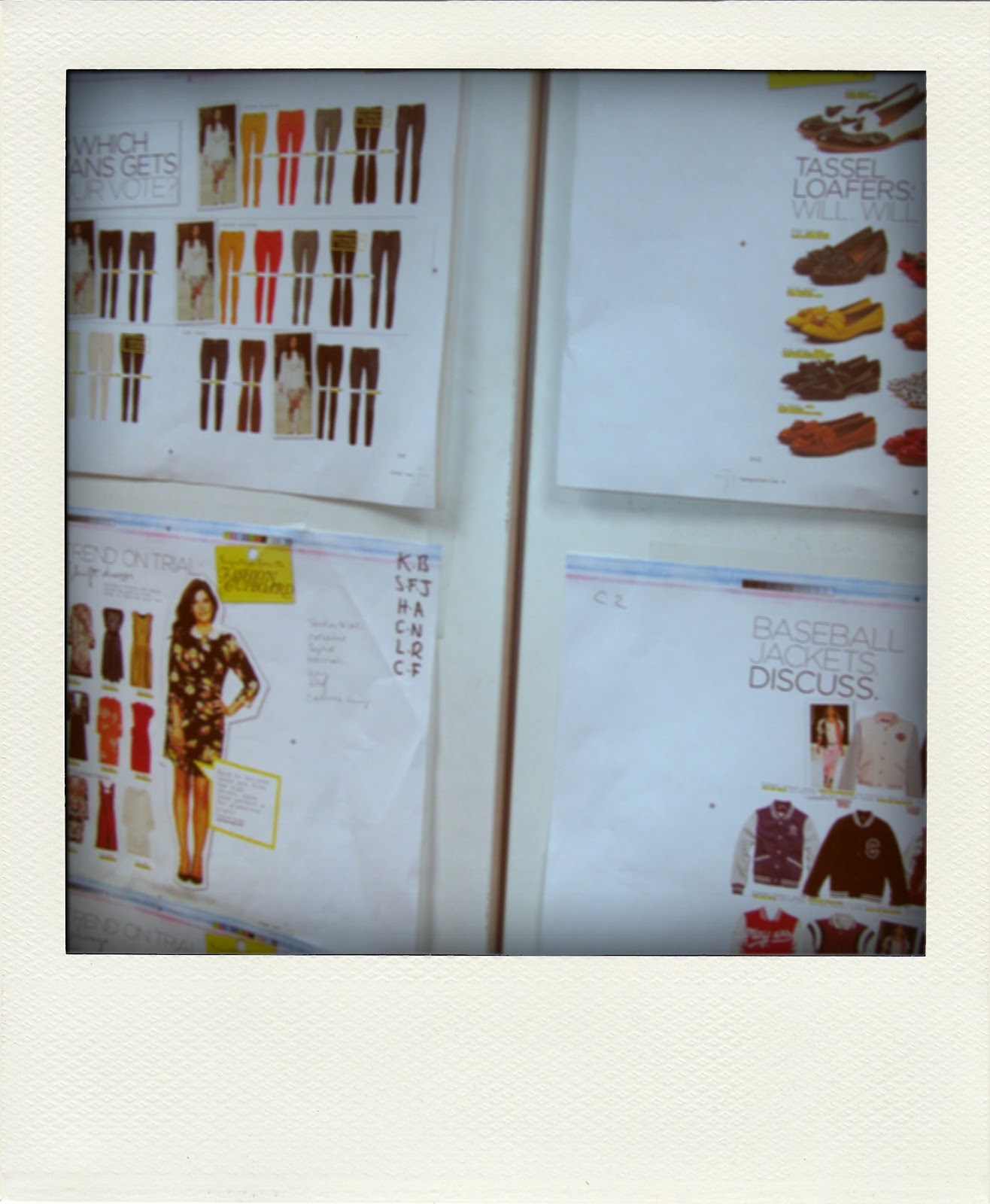
In order to make the magazine take shape, a visual mock-up is made. Sometimes you just can't see things properly until they're laid out in front of you, especially in terms of repetition, colour contrast and how the images sit against each other. Here you can see an example of a layout being tested, and it will end up full of annotations before the final edition is created.


Here's Grazia's Style Director Paula peeping out from behind her computer. Though we interrupted her, she - like everyone else in the office - was warm and welcoming. Behind her lay hundreds of box files full of important resources for her team, alongside a large whiteboard with a grid structure for the content needed over the course of a few issues.

This is how fashion is constantly monitored on a weekly glossy, requiring a large and dedicated team who are all on the ball.

Monday, 28 November 2011

British Fashion Awards 2011 - what do you think of the results?

So, the British Fashion Awards are over for another year. Here's who scooped the top accolades, and my responses:

Emerging talent award – ready to wear: Mary Katrantzou (this was to be expected. With her LFW status as the darling of the new design breed, and a diffusion line for Topshop, she was a dead cert here, but it's well deserved. I will be interested to see if she can keep her shapes evolving, though).

Emerging talent award – accessories: Tabitha Simmons (with lots of historical references and vintage nods in previous collections, particularly SS11, she's a designer who mixes the past and present effectively).

Emerging talent award – menswear: Christopher Raeburn (he's a great innovator and he's been on the ethical fashion radar for quite some time. I'm glad he's now got mainstream recognition. His recent LFW exhibition was really strong, with pieces suspended on ropes).

Accessory designer: Charlotte Olympia (I have previously posted about being a fan of hers, so unsurprisingly I'm pleased that she's been given this award. She keeps generating new ideas and updating the classics without compromising her integrity).

Menswear designer: Kim Jones (simplicity and edginess: two of my favourite menswear adjectives. He fits well with both of these descriptions, so it's a thumbs up from me).

Designer brand: Victoria Beckham (she works incredibly hard and really does know her fashion, contrary to her previous dalliances with WAG style and co-ordinating husband and wife ensembles. I never thought I'd call her an icon, but she truly is).

Model: Stella Tennant (yes, she's good, but I'd have preferred a buck in the trend of the last few years, which has been pale and interesting blonde women. Jourdan Dunn's triumphant win in 2008 seems ages ago. I feel like it's time for the BFAs to honour a more diverse image of British fashion modelling).

BFC outstanding achievement in fashion: Paul Smith (the creator of an empire that still generates quirky ideas to this day).

Isabella Blow award for fashion creator: Sam Gainsbury (having worked on the great Fashion Rocks events, which combined music and style, and more recently launching the McQ line for Alexander McQueen, she's also responsible for countless other fashion events. It's great that behind-the-scenes creatives are acknowledged - not just the designers themselves).

Red carpet award: Stella McCartney (another dead cert, as she's giving us an anniversary exhibition at LFW in February that will be separate from her catwalk collection, and there'll be a retrospective too).

Designer of the year: Sarah Burton for Alexander McQueen (after all the Kate Middleton hype, who else could it have gone to? Basically I think this would have gone to whoever had designed the Duchess of Cambridge's dress. Yes, Sarah Burton has been great taking over the helm at McQueen, but this award would have been all about that marriage).

New establishment award: Christopher Kane (intelligent, humble and very creative; I love seeing what he and sister Tammy come up with next. They're a design duo to be reckoned with).

British style award brought to you by Vodafone: Alexa Chung (well, she does represent the style ambitions of teenage girls across Britain, but I find her a little predictable. Sorry. Would have liked this to go to someone a bit more boundary-pushing, such as Paloma Faith).

*

What are your thoughts on these results? Do they feel representative of modern fashion to you, or do you feel like someone is missing from the list?

Thursday, 28 July 2011

Three Celebrity 'Creatives' = Three Braincells


[Image via shesomajor.com] Geri Halliwell has blessed the British high street (well, Next) with her talent for stitching pieces of satin together and adding some very 90s spaghetti straps in strategic places. Okay, I do like the shade of the navy one, but otherwise this is essentially a lesson in how celebrity 'designers' can rip people off. There is nothing memorable or unique about these dresses and, as you can see from the lanky models, only short people such as Geri will be able to get a gown that skims the floor.


[Image via BruceJuice]. Every time I read a gossip magazine article about young popstars such as the highly banal Pixie Lott being hailed as 'style icons', a little part of me dies inside. The girl has a stylist who chooses her clothes and guides her towards each trend, making it somewhat laughable that Lott now professes to be a fashion designer with her regular capsule collections for Lipsy. Her style drops include numerous 'reinventing the wheel' moments, such as the shift dress available in both black and white (oh Pixie, you spoil us with your innovation), floral dresses, playsuits and more floppy hats than you can shake a stick at. Similar pieces can be found at every single fashion outlet on the planet, for considerably less cash.


[Image from Fashion Fame, depicting Katy Perry's Purr promo]. The prerequisite for becoming a 21st century female celeb is to release your own perfume. It doesn't matter if you have any olfactory interests, or if you even know what olfactory means, because you will suddenly wake up one day dreaming of fragrance topnotes and a burning desire to make everyone smell your talent. In recent months we've been encouraged to buy into Jennifer Aniston (l'eau du permanently single female), Rihanna (l'eau du skimpy outfits and S&M videos) and Katy Perry (l'eau du awkward high-profile marriage). Perry perhaps tops the list for me, as she promoted her scent whilst dressed in a catsuit with a giant ball of twine. Catnip not included.

My plea to celebrities who want to cash in on their fifteen minutes of fame with a clothing or perfume range? GET BACK TO YOUR DAY JOB. Ditto Justin Bieber and his nail varnish for tweens, which is undeniably odd and desperate. Other viable alternatives for less random self-promotion are the ghost-written autobiography and the calendar; both of these are accepted as the norm and are much easier to stomach as a moneyspinner, because they make sense and they involve little effort. I require a celebrity to dress me about as much as I need a banker doing my hair, or a laywer cooking my dinner. Let's hope that we're not soon to be graced with L'eau du Ryan Giggs or the clothing range from Chipmunk. Fingers most definitely crossed.

N.B. Thanks to Holly Lowe for alerting me to the Geri Halliwell collection.

Tuesday, 17 May 2011

That Old 80-20 Balance

It's a well-quoted fact that most people wear only 20% of the clothes they own. But here are a couple more worrying facts on wardrobe waste (these facts are derived from the Daily Mail online, so they might not be 100% accurate and may contain conspiracy theories, but they're all I've got to go on at the moment...):


  • In 2007, there were three pairs of jeans being sold every second in the UK. I'm guessing they weren't all designer threads, either.
  • 80 billion new garments are produced every year.
  • Compared to women in the 1980s, the modern woman has 4 times as many items of clothing.
  • In 2005, supermarkets contributed 20% of the fashion market.
  • The average woman acquires 4 and a half stone of clothes per year. I would make a safe bet that I am way beyond that figure...

I am trying to beat my fast fashion addiction, I really am. I try and think of items that I already own which could work with the one I'm considering buying, or I justify 'price per wear' (which, when something costs £5, it's not hard to do). However, I still find it incredibly easy to tire of the things I buy and yearn for something new, yet be unable to physically abandon my cast-offs, lest I should need them again next season. Yes, there's probably some kind of emotional attachment issue going on there, but I love shopping and I don't like throwing away. That's just me. It's not going to be an easy task, but I really am going to try and be more brutal with my wardrobe choices and actually part with the items that never see the light of day.
Related Posts Plugin for WordPress, Blogger...